Engineering the future of thermal comfort through intelligent heat pump technology, low-GWP refrigerant platforms, and IoT-connected building systems.
Founded in 2004, DaikinAir began with a clear mission: to accelerate the global transition from fossil-fuel heating to efficient, electrified thermal systems. Starting with a single production line in Charlotte, North Carolina, we have grown into a 620-person organization with three manufacturing facilities serving 48 countries.
Today, our engineering team of 65 specialists develops heat pump systems that combine inverter compressor technology, IoT-enabled monitoring, and natural refrigerant compatibility. Every system we ship represents our commitment to decarbonizing the built environment while delivering measurable energy cost reductions for our customers.
Four principles that drive every engineering decision, product design, and customer interaction.
Every product decision starts with thermodynamic analysis and ends with independently verified performance data. We do not make claims we cannot measure.
Our 2030 net-zero manufacturing target and low-GWP refrigerant strategy reflect a genuine commitment to reducing the thermal sector carbon footprint.
We treat every project as a long-term technical partnership, not a transactional equipment sale. Our service contracts extend the relationship well beyond commissioning.
From AI-driven load optimization to digital twin modeling, we invest 8% of revenue in R&D to keep our platform at the frontier of heat pump technology.
Our Charlotte R&D center houses a 2,200 m² performance testing laboratory equipped with two AHRI 550/590 compliant calorimetric test chambers. Every heat pump unit undergoes a 72-hour burn-in test cycle covering startup, full-load, part-load (25/50/75%), and defrost sequences before shipment. Test data is archived for 15 years per ISO 17025 protocols.
Our refrigerant engineering team has completed over 340 circuit designs since 2017, including charge-minimized R-290 circuits with less than 150 g refrigerant per kW cooling capacity. Each design undergoes computational fluid dynamics (CFD) simulation and physical prototype validation before entering production.
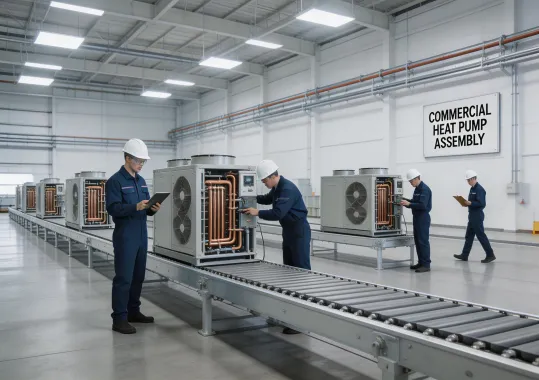
All three factories operate helium leak testing on every brazed and welded refrigerant joint, with a detection threshold of 1 × 10&sup5; mbar·l/s. Final assembly includes automated electrical safety testing (hi-pot, insulation resistance) and refrigerant charge verification by weight to ±5 g accuracy.
AHRI Certified
ISO 9001
ISO 14001
CE Marking
ASHRAE 90.1